Category: Uncategorized

  • Six Nights (2025) + Notes

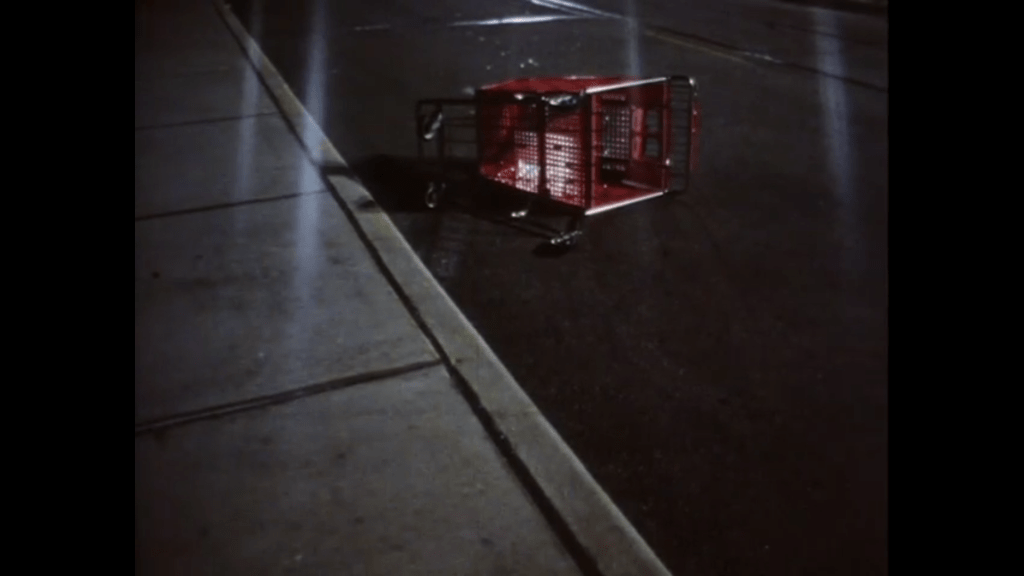
    Embedded above is my new short film, composed primarily of three (well, four really) shots and some audio recordings captured on my smartphone.

    NOTES:

    I would prefer that Six Nights speaks for itself, and whilst it is not my intention to use these notes to sway a particular reading or to justify its pretences, I still find myself compelled to openly reflect upon the process of its assemblance.

    As with my two previous shorts Houseplants and Falmouth Collage, the flow of the text did not become apparent to me until the edit. Yet unlike those works, there never was any intention to make these disparate shots and audio recordings into something cohesive. Often, whilst I am running errands or home alone or just bored, I’ll take out my phone and just start filming anything. Much of this is audiovisual nonsense, but some stuff compels me enough to investigate it more. Many of these shots are taken from train windows with the phone balanced against the glass, although they felt far more meditative to shoot than to rewatch. Some are so banal as to be self-destructive; confronted with the reality that the sublime – funnily enough – does not always emerge from a lack of effort.

    There is a distorted voice-over that populates the right side of Six Night‘s audio track. The passage is the only thing recorded with the intention of developing some formal cohesion, and was originally intended to be included in a clear and undistorted fashion. I will admit that there was some embarrassment over both my prose and my delivery that ultimately lead me to shroud it in abstraction. However, I was also displeased with how clearly it dictated a particular narrative direction. When I chose the three moments – a bus stop in the rain, an ajar door at night, and a lo-res close-up of a thunderstorm – the difficult part was not in finding a story to tie them together, but in allowing contingencies and experimentation to take control. Too often, anxieties around the hypothetical audience uncovering subtexts that betrayed or suggested some secret moral depravity or naivety crumpled my earnest desire to mess around and stick with what felt right.

    With that, have fun and enjoy the film.

  • Sleepwalk (1986)

    Sleepwalk (dir. Sara Driver, 1986)

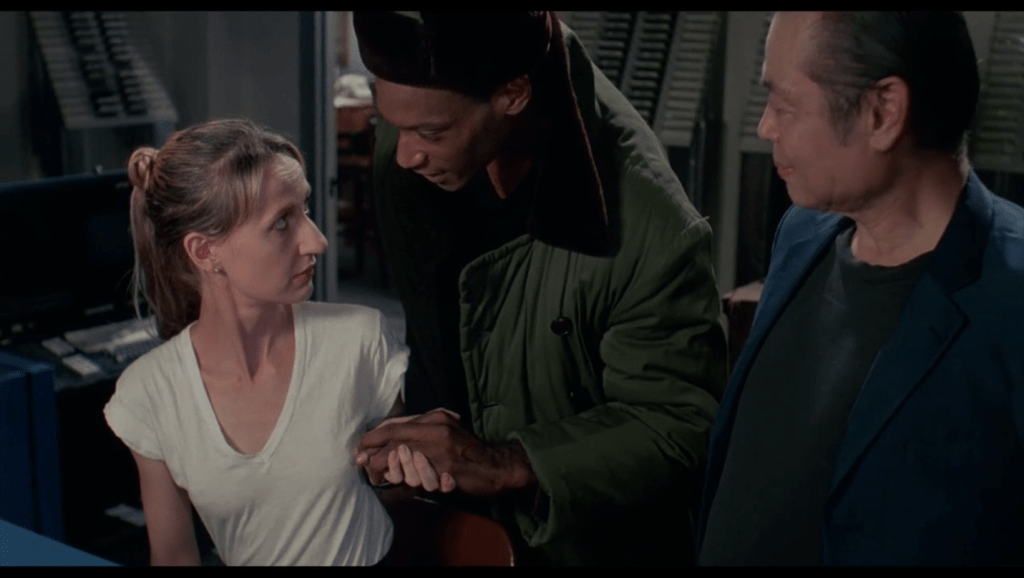
    When an evil goes unrecognised, it leaves a miasma. Everything the nameless evil touches suddenly feels worse. Paranoia is a byproduct that is unwanted and isolating, and yet entirely justified. Contradictions multiply when the contradiction itself is never solved, such is the nature of the unsolved dialectic. Many surfaces in Sara Driver’s Sleepwalk lead one to believe that an Oriental curse is this evil; that Nicole (played by Suzanne Fletcher) has awoken a force in need of soothing by translating an ancient Chinese manuscript stolen by two mysterious gentlemen. By its conclusion however, no curse has been solved. It transports her through the floors she never visited on her work elevator, and violently awakens the technology in her workplace, but its presence is never confirmed and its fate is left uncertain. Nicole’s future – with her son, her roomate, her work – is unknown.

    For those looking for conventional satisfactions, there are none to be found. By the end, we know more about the folks whose lives are intertwined in this curse than the curse itself; left to permeate their realities, if indeed it ever existed at all. A critical reading offers one interpretation: that this curse is merely an Orientalist scapegoat for the sly manoeuvrings of capital in an increasingly post-socialist world. Haywiring electronics may perhaps be coincidental, but their associations with the technologies of labour – in the space of metropolitan labour practice, a small New York City copyshop – foreground a negative energy that has begun to effect Nicole’s sense of personhood. The elevator opening at random floors to reveal new worlds unknown to her, including the base of the two men who gave her the manuscript to begin with, alienate but do not harm. Each floor thus reveals something outside of Nicole’s routine. Nicole’s son Jimmy (a young Chinese-American boy) and her roomate Isabelle (an illegal European immigrant) are never the scapegoated target of her ire. Indeed, they are the worst victims of this curse; as Jimmy is unintentionally kidnapped, and Isabelle’s hair begins to fall out.

    Whilst I don’t disagree that this reading remains part of Sleepwalk‘s ideological core, its aesthetic distancing is its core message. Its deliberate play with convention – not along lines of symbolic pastiche but via its technical principles, or even the material implications of pastiche – is not as nihilistic as New York’s No Wave is often viewed as being. That its aesthetic register is so stark, ironic, and patient – yet emotion-, image-, and actor-forward – implies that its concern is with the aesthetic/affective politics of the neoliberal moment. Driver’s New York is like that of Chantal Akerman’s News from Home, but haunted; soaked in irony-with-sincerity. This choice not only renders Orientalism gauche and contrived in this universe, but fundamentally unsatisfying as a principle. One needs to delve deeper, but the language for it is missing. In this sense, Sleepwalk is typically No Wave: confrontational in its own distance, whilst developing its own aesthetic via the discordance between capital’s symbolic and material reality. I am surprised then that it remains so underappreciated in the canon of No Wave cinema. Especially so given Sara Driver’s respect in the NYC indie film circuit, early performances from the likes of Tony Todd and Steve Buscemi that seem primed for rep house cratedigging, and the prominence of its cinematographer Jim Jarmusch. Maybe it came too late, just as its practitioners and aesthetics dissipated and postmodernity began to militantly incorporate any and all aesthetics into itself. Maybe it’s not late enough.

  • One Battle After Another (2025): Lockjaw, Sex, and Fascism

    Spoilers for One Battle After Another ahead.

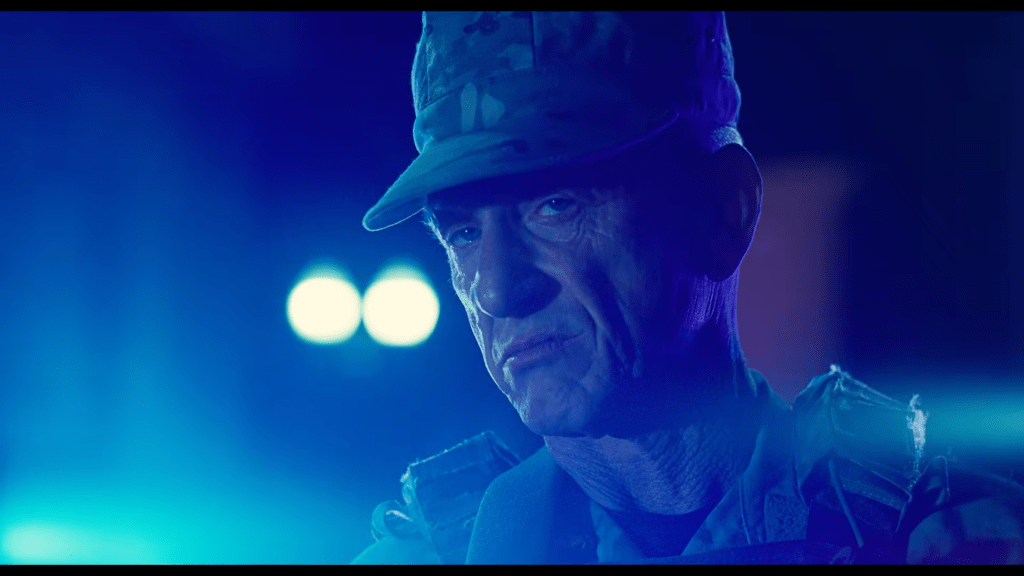
    Sean Penn as Col. Steven Lockjaw

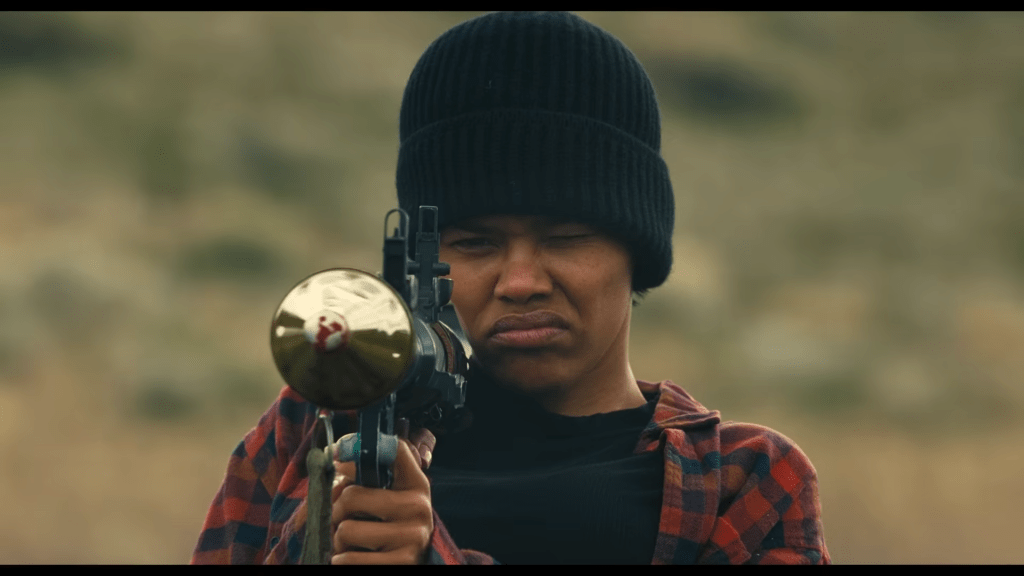
    At the beginning of One Battle After Another, Paul Thomas Anderson flirts with a defeatism, seemingly rationalised via biology: the inability to escape the sexual drives which transcend all ideology. Amidst the militantly organised liberation of a migrant detention centre by rebel outfit The French 75, Perfidia Beverly Hills (played by Teyana Taylor) confronts head of the detention operation Colonel Steven Lockjaw (played by Sean Penn). Polar opposites in the heat of battle, there is still an undeniable force between them: Lockjaw’s feverish sexual obsession with her, and Perfidia’s own desire to control him through this obsession – one which she enjoys, but can casually play off given the circumstances. This play of sexual power presents an initial dilemma – what does the right hold that the left doesn’t, and vice versa? What is to be made of the radical if the conservative is so alluring? Are we thus faced with, to quote Jacques Derrida, a vis a vis? Is there a compromise?

    The rest of the film, however, is not content with this. Indeed, their “union” reflects the core ideological conflict that underpins the film – that is to say, we live in the aftermath of the vis a vis. This is a fake co-existence that presents itself as truth and freedom, but has only violently exacerbated the forces of the right; stagnating the present in a turmoil where the libidinal frustrations of then not only resonate now, but have become far cruder; far more unsatisfied; restless; esoteric; fascistic. Our mistake is in thinking that the libido instils a necessary compromise. Instead, the libido insists that there is a field that the left – the ‘radical’, the ‘revolutionary’ – has yet to fully appreciate or understand. Perfidia was a rat, and the vibrancy of her rhetoric conflicted with an incomplete (albeit determined) desire for radical action, but she was not wrong to lust. Libido is not a trap which will always halt radical action. It is, however, rooted in the anxieties and dissonances which inform our spirits. Her charged intimacies with Lockjaw merely manifest her own structural desires; which transcend ideology in so far as she wishes to be rid of the ideological fight – for herself, more than for her friends and family. This is why she flees the home that Lockjaw helped her secure in witness protection, as the reality of her libidinal limits have become all too apparent. She must run, for staying will never grant her rest. This is decidedly not Thomas Pynchon’s Vineland; where the flaccid utopianism of 60s hippiedom has been replaced by the CIA philosopher-kings of Brock Vond. In Anderson’s world, the cultural rot has already set in. Everything is the same as it was 16 years before, only with different shades and patinas. Its racisms are grizzled but with a post-familial legacy far beyond that of its radical counterpart (a brilliant cameo from veteran Kevin Tighe epitomises this). There is nothing of Mark Fisher’s acid communism, only an unsolved libidinal maze.

    Teyana Taylor as Perfidia Beverly Hills

    In this vein, though the central narrative is between Bob Ferguson (aka – Rocketman, or ‘Ghetto’ Pat Colhoun) and his daughter Willa (aka – Charlene Calhoun), it is Steven Lockjaw who becomes the de facto main character. Lockjaw is a man whose military life has long been the manifestation of a repressed libido, unable to come to terms with who he is as a white heterosexual man in a world that despite his best efforts is always moving beyond him. He must find security in the hegemony, so much so that he strives to join the Christmas Adventurers Club: an elite cult of white supremacists whose connections to the abstract avenues of capital – military, industrial, state, local, wherever and however – are what Lockjaw strives for. He wants to be like these guys. Gilleted and wanting for nothing, sleek in their WASP-ish charms, and unencumbered by fragilities. But Steven Lockjaw is a fragile man. His militant stride is both affected and naturalised. Whilst not short, he is shorter than the men around him, and thus attempts to command a mannekinesque authority. Anderson gets “on his level”, often shooting from low angles, but such pretences rarely grant him the authority he desires. He has a gnarled face, constant mouth ticks, overly-militant expressions, and uses spit as hair gel for an atrocious hairstyle that reads as a naive alt-right undercut. He reads as a man who has spent so many hours staring at his peculiarities in the mirror that he has forgotten about the very spirit which that vessel carries. His hatred for non-white folk has all to do with wanting more for himself; for securing a place that the military has been unable to entirely grant him. His attraction to Perfidia – a black woman whose relationship to her race is far more radical and open than Lockjaw’s own relationship to his whiteness – is a contradiction. Yet more significantly, this element of his attraction becomes violently intensified as he cannot view his own libido beyond the structures of race and capital that he has devoted himself to in the pursuit of a calmness to his restless inner spirit.

    It is the strive for him to eliminate all traces of his association with the Other that thrusts the film forward, reigniting a momentary revolution for which he is the villain to overcome. Of course, destiny has another fate for him. The revolution never gets close to harming him really. Even when Bob has him in the sights of his sniper, he misses and Lockjaw keeps on walking as if nothing has happened. He gets close to death when, after finally kidnapping Willa and leaving her fate in the hands of a white supremacist sect of the military, a hitman hired by the Christmas Adventurers – after discovering his relationship to Perfidia and the existence of their child, Charlene/Willa – shotguns him in the face, causing him to career his car off the road. He somehow survives, striding back towards us with a face bloodied and mangled. After the dust has settled and his face has healed into a permanent scar, he returns to the Christmas Adventurers, ignorant of their initial plan. Thinking that he has finally made it into their echelons, he is guided to an office where he is locked in, quietly gassed to death, and then quickly cremated. A bigger and more efficient power works beyond him, despite his apparent control over military might and a state apparatus that is seemingly at his command and willing to divorce violent personal action from violent political action. To reference another DiCaprio film, he is this story’s Ernest Burkhart – a man too ignorant and blinded by desire to realise his role in the grander scheme of capitalist oppression but likewise a repugnant pawn who ends up a squirming figurehead of the libidinal hegemony. The title – One Battle After Another – thus rears its head again: there is always more work to be done.

    Put simply, Lockjaw is a caricature of the fascist libido; or at least one strain of it. He is a caricature in this sense that in the will to conceive of sexual politics along such masculinist conservative lines – a casualised sadomasochism devoid of consent, mutuality, and tenderness – the contradictions bloom into the esoteric and the abstract; the frightening tentacular paradoxes which only grow stronger and more numerous the more you resist. When we speak of genres being bodily – to hint at Linda Williams’ seminal ‘Film Bodies’ – the narrative’s evolution into suspense action drama seem almost to be the translation of Lockjaw’s lack of fulfillment; pushed onto everyone around him and into cinematic spacetime. Bob and Willa Ferguson’s world ripples and clunks at Lockjaw’s repressions now that he has announced himself on the stage of the uber-fascists themselves, with no hope of turning back other than the death which ultimately befalls him. Perhaps this is why Paul Thomas Anderson sacrifices some of the stronger compositional tendencies of works like Inherent Vice or The Master. Instead, he opts for something closer to an affective continuity or montage: a stronger sense of images in flow and transition, as meaning arriving from something less causal and more spasmodic and tortured; desperate for a climax.

  • Raven Hawk (1996)

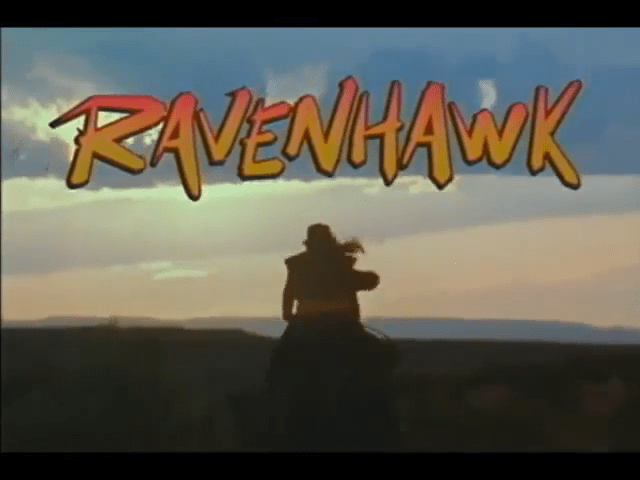
    Any critique of this film I try to make is swallowed up by the overwhelming presence of one word: machismo – or, to be flippant, femmachismo. Raven Hawk‘s fascination with the gendered body makes for an interesting refraction of the hypermasculinity of 80s action cinema – specifically the hulking Americanised brand: Arnold Schwarzenegger, Jean-Claude van Damme, Chuck Norris, Steven Segal, Sylvester Stallone. It’s nothing new to observe the conservative undercurrents of the phenomenon – especially now when the masculine exceptionality of these archetypes has become the fascistic consensus of American cinematic bodies (Marvel and DC, for sure, but perhaps more strikingly in romantic comedy – think Anyone But You). Raven Hawk’s female protagonist Rhyla Shadowfeather conveys the film’s desire to invert this 80s corporate machismo, by casting bodybuilder and two-time Ms. Olympia champion Rachel McLish.

    The film operates around a typical revenge exploitation narrative: a young indigenous Shoshone girl framed for the murder of her family by white corporate landgrabbers, who seek to build a nuclear waste facility on the tribal reservation. Years later, she escapes prison to seek purifying brutal vengeance upon the perpetrators. The film takes great pains in showing you Shadowfeather’s primary weapon of choice: her body. Shadowfeather’s (and thus McLish’s) body becomes the central cinematic locus – what she can do with it, what it looks like, how others perceive it. Dialogue between the male antagonists aim to position the film as a feminist one, as her muscular body becomes the subject of aggressive sexualisation (and, correspondingly, racialisation – even if McLish herself is not Shoshone, or of indigenous heritage at all). After she drops one of the antagonists from a bridge, his colleague – seemingly unaware of his previous actions – is asked to describe her appearance. When asked if she was muscular, his response – akin to “jeez, now you mention it!” – further aims to position the film’s progressive stance on female bodily autonomy. Yet the film shares in this fetishism, forgiving itself of objectification by claiming to elevate the female form to that of the ‘masculine’ ideal. All this is not to dismiss the gratifications of the female bodybuilding community as somehow less ‘womanly’, of which McLish is a foundational figure. On the contrary, whilst Raven Hawk claims to offer a counter to a feminine bodily ideal, it does so by distorting the politics of bodybuilding to one of a masculinist fetishism of power. Even then, her body is still objectified. In a moment where Shadowfeather retreats to a cave, the camera lingers across the back of her nude form. In her meditative catatonia, she flexes and poses, her shoulders and arms silhouetted against the campfire but still reflecting the muscular angles of her physique. As Outlaw Vern notes, the scene was originally intended to be shot entirely in the nude, until McLish expressed last minute that she did not feel comfortable doing so. Pyun, however, pushed her to stick to her commitment. The end result is a “compromise”; a technically-nude – but not exactly consensual – scene where a side profile of her bare breasts is displayed voyeuristically. Depictions of her muscularity – and thus, the film’s visual ideology – collapses into the same realm of objectification that it claims to critique.

    Rachel McLish for Life Magazine.

    This is at least part of the reason why I’ve never been able to fully get on board with the Pyun re-evaluation hype. There is something singular about his work which portends a vulgar auteurist framing; especially films such as Nemesis and Radioactive Dreams which display a craftsmanship beyond the rote Cannon-isms that many of his other films exude. I am also willing to give him some credit for Captain America. It is by no means a masterpiece, but it has been so critically caught up in the self-serious and impotently-ironic pretences of contemporary Hollywood cinema – a la Russo brothers – that its actual ambitions are too easily dismissed. Yet the issue that blights Pyun’s films (Raven Hawk included) above all else – even beyond the financial periphery that is now canon to his biography – is this naive emblazoning of Hollywood’s ideological codes. Raven Hawk sees itself within the legacy of films like First Blood and Raw Deal – even its femmachismo sisters Aliens or Ballistic – and, I would argue, holds its own in many aspects. For instance, Pyun regular George Mooradian’s cinematography is far more compositionally-rigorous than a straight-to-TV production usually strives for; like it was content to play the long game of waiting for the days of 4:3 CRTs to be over. Yet in its desire to be both above and a part of Hollywood’s sexual ideologies, without due consideration as to how the two interact, we end up here: an ex(r)oticised hotchpotch.