“The police conventionally say: “We have a situation here.” A situation is a state of things in which something that will perhaps matter is unfolding amid the usual activity of life. It is a state of animated and animating suspension that forces itself on consciousness, that produces a sense of the emergence of something in the present that may become an event. This definition of situation resonates with the concept’s appearance in Alain Badiou’s work with the “event,” but for Badiou the event is a drama that shocks being into radically open situations -the event constitutes the potential for a scene of ethical sociality.”
Lauren Berlant, Cruel Optimism, p. 5
Written into the social materials – the architecture, the lights, the roads, trees, rivers, pavements, silence – of urban nightlife is the anticipation of violence. This is more than a preternatural diurnal dislike of the dark. It is an ethics constructed by and alongside the flow of daily life; the strangeness of a sprawl which signals something elicit or forbidden when navigated outside of the Usual Hours. What then can be gleaned from taking on the vantage point of those who monitor this nocturnal ethic? What else is revealed about these spaces when we, to flirt with advocacy, put ourselves in the emotional position of systemic brutality?
Deborah Stratman’s In Order Not To Be Here does not sympathise with law enforcement, although there is perhaps a bitter twang of empathy which is more important learned from than appreciated. The cinematic form, which navigates its emotional dimensions through the interplay of audiovisual time and movement, is perhaps the only way that the emotional realities of surveillance can be communicated; can be rendered into a self-conscious cultural artefact beyond its place in a systemic operation. Harun Farocki, with Prison Images (2000) and The Creators of Shopping Worlds (2001), has sought to dissect this dynamic but in his usual observational style holds a more sober distant position. In Order Not… takes on that narrative affective challenge, studying with ironic immersion the affective hierarchies of policing.
Boredom is perhaps the film’s biggest statement on this front, formulating a conversation about how boredom works in the context of surveillance. Very little meaningful human activity actually happens in these spaces, on-screen – but in that absence, a search begins. One can lie back and appreciate the strange beauty of these spaces and images, either at an unnamed sympathetic remove or with critical satisfaction, but one first needs the emotional and intellectual capacity to receive such feeling. Police officers, regardless of their individual moral allegiances and naivete, are locked into an emotional regime through their occupation and social arrangements. Emptiness becomes the sight of potential ‘events’, a constant teasing that becomes irrational and violent when an ‘event’ arrives – and, of course, it never really does (at least, not in the way one ever expects it too). These spaces, under the visual regime of boredom, are always about a violence yet to happen. Stratman makes it abundantly and hilariously clear to us that we are in the position of the police when, as a brief excursion, we find ourselves in a doughnut shop. Yet there is still a banality written into this excursion, as if it were not an excursion at all but spiritually – structurally, metaphorically, materially – part of the same moral universe which these police have sought to escape.
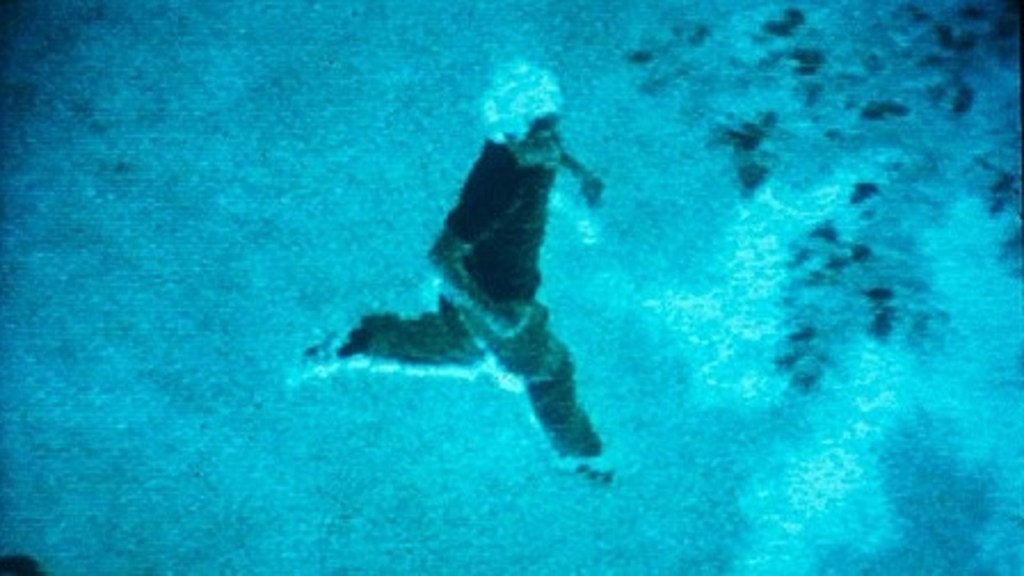
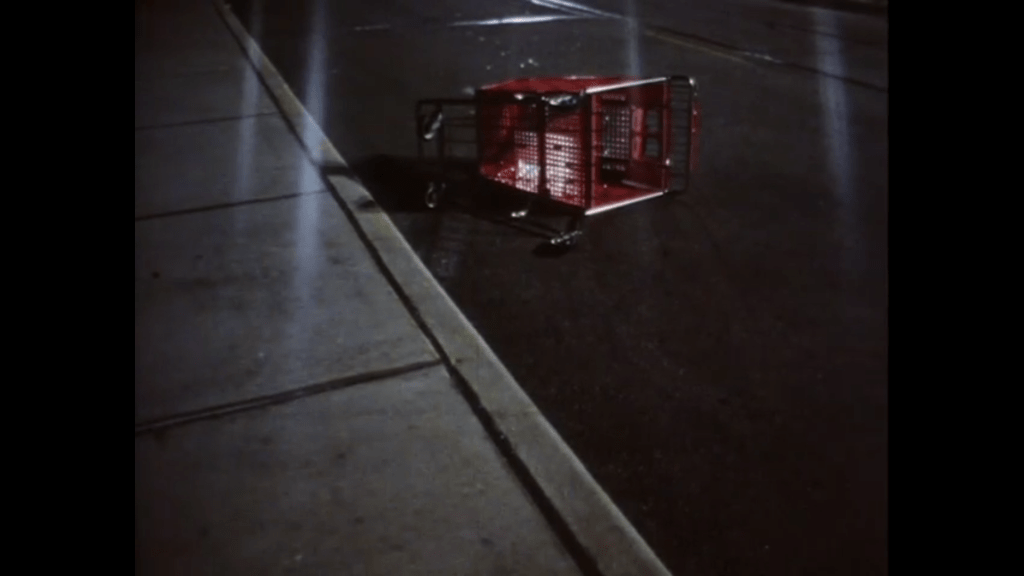
Impossible to ignore, however, are the contrasts with a politics of excitement. Breaking through the mundane are brief moments of violence and suggestion. A radio transmission of violent ‘events’ happening elsewhere creates a kind of fear-of-missing-out, even as the ‘event’ sounds so far from what we – at our privileged remove – would find comfortable. Between two placid shots of a cash machine and a car park at a pharmacy is a short cut to an overturned trolley, with sirens blaring and people screaming off-screen, and a light gently flickering somewhere in the distance. This moment is both a premonition and the present. In its aching immanence, something must happen eventually, and often when it does, the joy is fleeting but is still so powerful when felt in contrast to that lack – or anticipation – of action. After this otherwise slow stream of nighttime shot, we are thrust into the perspective of a helicopter’s night-vision camera, hunting down a fugitive – named in the credits as “Running Man” – through the various phases of urban sprawl: car parks, forests, pavements, and rivers. One is locked into the chase throughout, with an implicit narrative compelling us to ask whether he will get caught or escape. When he briefly evades the camera’s detection by escaping into the woods, we take pleasure in observing the techniques the operator uses to find him again: the zooming and re-orientation, tracking his possible path, and anticipating where and when he emerges. In this sense, the technology is gamified; another layer in surveillance’s technological-emotional regime. Provocative as is to say, the quality of watching this moment is akin to watching a faceless Twitch stream, as we become participants in a layering of narratives at a remove from the material implications, and our observations on technique rewarding our pattern-seeking desires in this new emotional regime. Ultimately, the fugitive’s fate is left unknown because – in truth – it really doesn’t matter. Appropriate then that the film begins with the conclusion of a similar chase, suggesting to us that the possibility of capture is its own reward; a blueprint of what could happen rather than what necessarily will.
In Order Not…’s chase and spectral violence are thus not bound to rational duty but are played out as rewards for hours of mindless observance, unapproachable when consumed only in that singular restrictive context; a thrilling narrative built upon the expectations of surveillance. It is quite purposely orgasmic in its construction – and therein lies one of the libidinal satisfactions that give surveillance work its dangerous capitalistic appeal. That these excitements are bound so much to inhuman perception – the technologies that claim to ‘enhance’ human sensory experience but really only formulate a visual language built for human limits – demonstrates how this technological hierarchy is intimately bound to the libido. Or, in short, human perception is limited and boring, technology is liberating and moral – any nuance or deconstruction is an irrational moral failure.
The challenge here – and one I would argue that Stratman poses through the film – is to re-curate the ideological duality of boredom and joy. Re-centring emotions as material arrangements in complex and oft-contradictory political oppression is crucial to overcoming how a regime finds popular and spiritual traction. An essay written by Lieutenant Arthur Doyle, a long-term NYPD officer, epitomises this quandary. Amidst decades surrounded by brutality and the blue wall of silence, he remains confused as to why more minorities don’t throw themselves at the opportunity to enlist and change policing from the inside. Regard the following statement:
“In talking with kids about the police force, I use several raps. I tell them it’s not boring. I never had a boring day in twenty-nine years.” (Doyle, 2000, pp. 182-183).
I don’t think Doyle, before writing this essay for the anthology of systemic critiques that surround it, ever stopped to think why it wasn’t boring. The world of policing does not just conjure these moments of entertainment out of a context-less void. Senses of joy are intimately written into (what Sara Ahmed calls) a “cultural politics of emotion” that dictates which emotional valences and intensities are valid, to be cherished and fostered (Ahmed, 2004, p. 3). Technology is but one part of it, which is perhaps why In Order Not To Be Here‘s most telling segments use trusty 16mm as a handy symbolic stand-in for unadorned perception, bypassing a problematic techno-phobic conceit. Remarkable is how this film understands that cop mentality – that which bends towards endless inwardness, a barbaric automatism that is both blind to and in allegiance with abstract duty – exists as part of the same inward logic of capital; inextricably part of the state’s waning towards neoliberal satisfactions. And there is a further brilliance to be found in how it holds such faith in cinema as an emotional vector; and the optimism it requires to view and create a cinema that is so resolute in that belief.
CITATIONS
Ahmed, Sara. (2004). The Cultural Politics of Emotion. Edinburgh University Press: Edinburgh.
Berlant, Lauren. (2011). Cruel Optimism. Duke University Press: NC.
Doyle, Arthur. (2000). ‘From the inside looking out: twenty-nine years in the New York Police Department’. in Jill Nelson (ed.). Police Brutality: An Anthology. W W Norton & Company: NY, pp. 167-184.
 Daniel E. Smith
Leave a comment