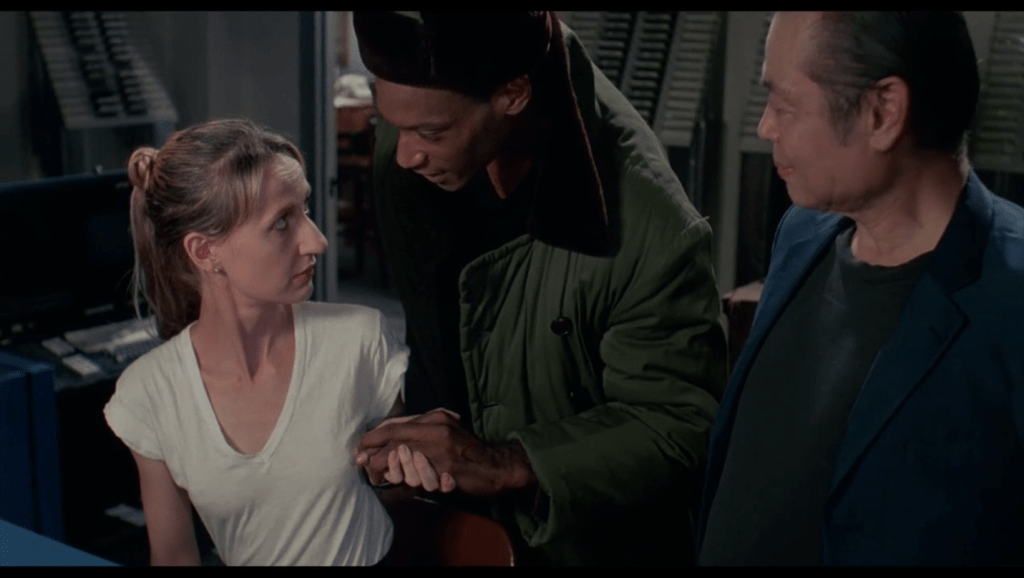
When an evil goes unrecognised, it leaves a miasma. Everything the nameless evil touches suddenly feels worse. Paranoia is a byproduct that is unwanted and isolating, and yet entirely justified. Contradictions multiply when the contradiction itself is never solved, such is the nature of the unsolved dialectic. Many surfaces in Sara Driver’s Sleepwalk lead one to believe that an Oriental curse is this evil; that Nicole (played by Suzanne Fletcher) has awoken a force in need of soothing by translating an ancient Chinese manuscript stolen by two mysterious gentlemen. By its conclusion however, no curse has been solved. It transports her through the floors she never visited on her work elevator, and violently awakens the technology in her workplace, but its presence is never confirmed and its fate is left uncertain. Nicole’s future – with her son, her roomate, her work – is unknown.
For those looking for conventional satisfactions, there are none to be found. By the end, we know more about the folks whose lives are intertwined in this curse than the curse itself; left to permeate their realities, if indeed it ever existed at all. A critical reading offers one interpretation: that this curse is merely an Orientalist scapegoat for the sly manoeuvrings of capital in an increasingly post-socialist world. Haywiring electronics may perhaps be coincidental, but their associations with the technologies of labour – in the space of metropolitan labour practice, a small New York City copyshop – foreground a negative energy that has begun to effect Nicole’s sense of personhood. The elevator opening at random floors to reveal new worlds unknown to her, including the base of the two men who gave her the manuscript to begin with, alienate but do not harm. Each floor thus reveals something outside of Nicole’s routine. Nicole’s son Jimmy (a young Chinese-American boy) and her roomate Isabelle (an illegal European immigrant) are never the scapegoated target of her ire. Indeed, they are the worst victims of this curse; as Jimmy is unintentionally kidnapped, and Isabelle’s hair begins to fall out.
Whilst I don’t disagree that this reading remains part of Sleepwalk‘s ideological core, its aesthetic distancing is its core message. Its deliberate play with convention – not along lines of symbolic pastiche but via its technical principles, or even the material implications of pastiche – is not as nihilistic as New York’s No Wave is often viewed as being. That its aesthetic register is so stark, ironic, and patient – yet emotion-, image-, and actor-forward – implies that its concern is with the aesthetic/affective politics of the neoliberal moment. Driver’s New York is like that of Chantal Akerman’s News from Home, but haunted; soaked in irony-with-sincerity. This choice not only renders Orientalism gauche and contrived in this universe, but fundamentally unsatisfying as a principle. One needs to delve deeper, but the language for it is missing. In this sense, Sleepwalk is typically No Wave: confrontational in its own distance, whilst developing its own aesthetic via the discordance between capital’s symbolic and material reality. I am surprised then that it remains so underappreciated in the canon of No Wave cinema. Especially so given Sara Driver’s respect in the NYC indie film circuit, early performances from the likes of Tony Todd and Steve Buscemi that seem primed for rep house cratedigging, and the prominence of its cinematographer Jim Jarmusch. Maybe it came too late, just as its practitioners and aesthetics dissipated and postmodernity began to militantly incorporate any and all aesthetics into itself. Maybe it’s not late enough.

 Daniel E. Smith
Leave a comment