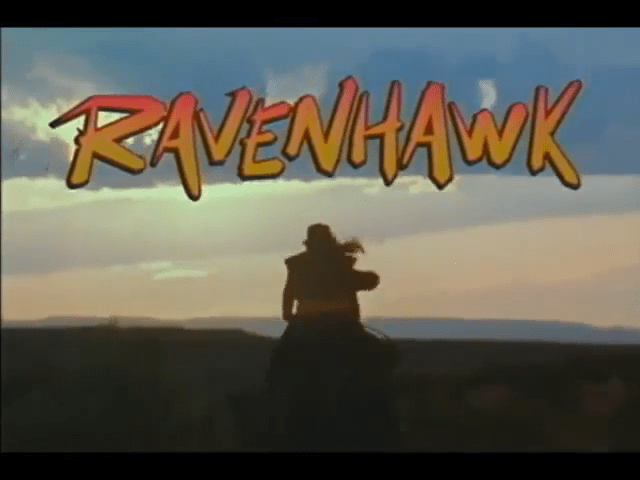
Any critique of this film I try to make is swallowed up by the overwhelming presence of one word: machismo – or, to be flippant, femmachismo. Raven Hawk‘s fascination with the gendered body makes for an interesting refraction of the hypermasculinity of 80s action cinema – specifically the hulking Americanised brand: Arnold Schwarzenegger, Jean-Claude van Damme, Chuck Norris, Steven Segal, Sylvester Stallone. It’s nothing new to observe the conservative undercurrents of the phenomenon – especially now when the masculine exceptionality of these archetypes has become the fascistic consensus of American cinematic bodies (Marvel and DC, for sure, but perhaps more strikingly in romantic comedy – think Anyone But You). Raven Hawk’s female protagonist Rhyla Shadowfeather conveys the film’s desire to invert this 80s corporate machismo, by casting bodybuilder and two-time Ms. Olympia champion Rachel McLish.
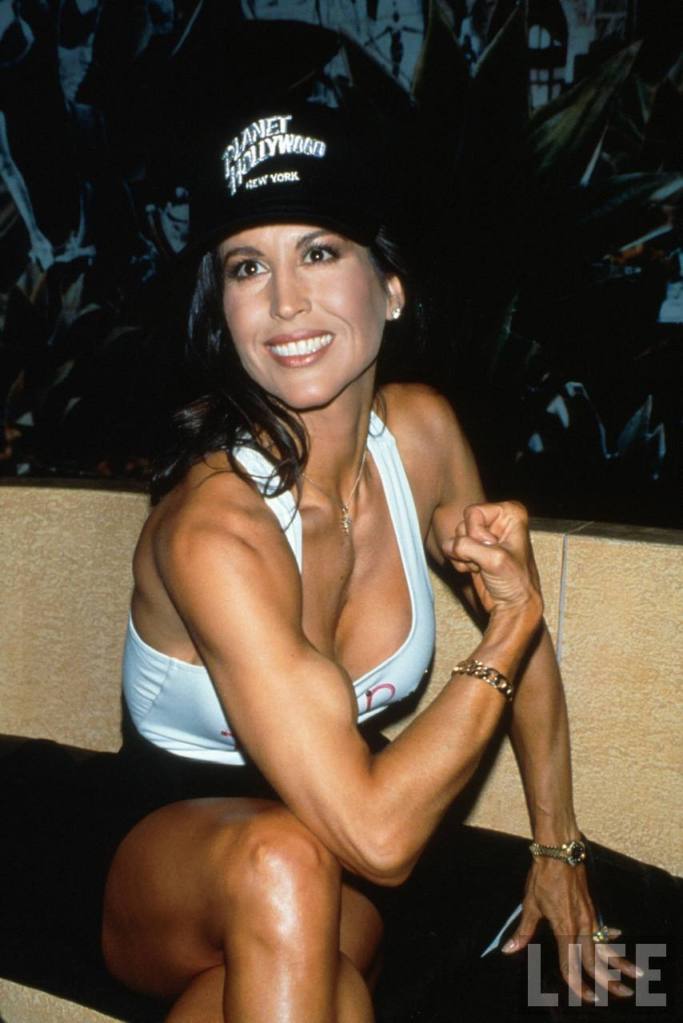
The film operates around a typical revenge exploitation narrative: a young indigenous Shoshone girl framed for the murder of her family by white corporate landgrabbers, who seek to build a nuclear waste facility on the tribal reservation. Years later, she escapes prison to seek purifying brutal vengeance upon the perpetrators. The film takes great pains in showing you Shadowfeather’s primary weapon of choice: her body. Shadowfeather’s (and thus McLish’s) body becomes the central cinematic locus – what she can do with it, what it looks like, how others perceive it. Dialogue between the male antagonists aim to position the film as a feminist one, as her muscular body becomes the subject of aggressive sexualisation (and, correspondingly, racialisation – even if McLish herself is not Shoshone, or of indigenous heritage at all). After she drops one of the antagonists from a bridge, his colleague – seemingly unaware of his previous actions – is asked to describe her appearance. When asked if she was muscular, his response – akin to “jeez, now you mention it!” – further aims to position the film’s progressive stance on female bodily autonomy. Yet the film shares in this fetishism, forgiving itself of objectification by claiming to elevate the female form to that of the ‘masculine’ ideal. All this is not to dismiss the gratifications of the female bodybuilding community as somehow less ‘womanly’, of which McLish is a foundational figure. On the contrary, whilst Raven Hawk claims to offer a counter to a feminine bodily ideal, it does so by distorting the politics of bodybuilding to one of a masculinist fetishism of power. Even then, her body is still objectified. In a moment where Shadowfeather retreats to a cave, the camera lingers across the back of her nude form. In her meditative catatonia, she flexes and poses, her shoulders and arms silhouetted against the campfire but still reflecting the muscular angles of her physique. As Outlaw Vern notes, the scene was originally intended to be shot entirely in the nude, until McLish expressed last minute that she did not feel comfortable doing so. Pyun, however, pushed her to stick to her commitment. The end result is a “compromise”; a technically-nude – but not exactly consensual – scene where a side profile of her bare breasts is displayed voyeuristically. Depictions of her muscularity – and thus, the film’s visual ideology – collapses into the same realm of objectification that it claims to critique.
This is at least part of the reason why I’ve never been able to fully get on board with the Pyun re-evaluation hype. There is something singular about his work which portends a vulgar auteurist framing; especially films such as Nemesis and Radioactive Dreams which display a craftsmanship beyond the rote Cannon-isms that many of his other films exude. I am also willing to give him some credit for Captain America. It is by no means a masterpiece, but it has been so critically caught up in the self-serious and impotently-ironic pretences of contemporary Hollywood cinema – a la Russo brothers – that its actual ambitions are too easily dismissed. Yet the issue that blights Pyun’s films (Raven Hawk included) above all else – even beyond the financial periphery that is now canon to his biography – is this naive emblazoning of Hollywood’s ideological codes. Raven Hawk sees itself within the legacy of films like First Blood and Raw Deal – even its femmachismo sisters Aliens or Ballistic – and, I would argue, holds its own in many aspects. For instance, Pyun regular George Mooradian’s cinematography is far more compositionally-rigorous than a straight-to-TV production usually strives for; like it was content to play the long game of waiting for the days of 4:3 CRTs to be over. Yet in its desire to be both above and a part of Hollywood’s sexual ideologies, without due consideration as to how the two interact, we end up here: an ex(r)oticised hotchpotch.
 Daniel E. Smith
Leave a comment